In the last few years, the phrase “The Matilda Effect” has started popping up around the internet, and it’s a big enough deal that I’ve written a whole children’s nonfiction book about it. But what exactly is the Matilda Effect? I’m so glad you asked. :)
What is the Matilda Effect?
Margaret W. Rossiter was a scholar specializing in the history of science. In 1993, she published a paper that begins like this:
In his autobiography Enigmas of Chance, mathematician Marc Kac described his 1980 trip to Poland to deliver the Marian Smouchowski memorial address in honour of the almost forgotten physicist of the past. Kac attributed Smoluchowski’s near obscurity in 1980 not to his death at age 45, nor to his long name, nor to his career in Eastern Europe, but to the “Matthew Effect” of having been eclipsed by Albert Einstein, who also worked on Brownian motion at about the same time. In 1968, Robert K. Merton named for Matthew of the New Testament a kind of ‘halo effect’ experienced by well-known scientists who find work attributed to themselves which they did not do (or did not do totally alone), or as written in the Gospel according to Matthew: “For whomsoever hath, to him shall be given, and he shall have more abundance; but whomsoever hath not, from him shall be taken away even that he hath. (13:12)
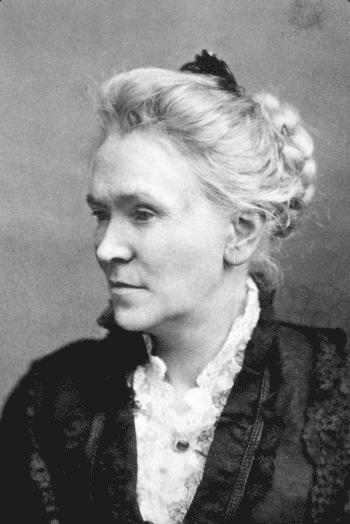
Matilda Joslyn Gage
In plain language: once people know a male scientist’s name, they tend to give him credit for the discoveries of other men.
Quite a lot of the time, they also give him credit for discoveries made by a female scientist. Especially if she was married to him at the time.
Rossiter called this systematic erasure of women in science the “Matilda Effect,” after a force of nature named Matilda Joslyn Gage.
Who Was Matilda Joslyn Gage?
Matilda Joslyn was born in New York state in 1826. Her mother was an amateur historian and her father was a doctor who believed that girls, including his daughter, should have the same right to an education that boys did. Matilda’s dad tried to help get her into medical school, but at the time, American medical programs did not accept women.
Years later, Matilda wrote,
I am indebted to my father for something better than a collegiate education. He taught me to think for myself, and not to accept the word of any man, or society, or human being, but to fully examine for myself.
Matilda’s thoughtful examination of 19th century American society told her that it was riddled with injustice. Millions of Africans were still enslaved, and under the laws of the day, married women were the legal property of their husbands, unable to vote, sign contracts, or own their own ideas. Matilda would not stand for this. She wanted an America where every person, regardless of racial or gender identity, had equal rights under the law.
Matilda married Henry Gage and they had five children (four that survived infancy). In 1852, she attended her first Woman’s Rights Convention, where she made a speech about women erased from history that set the crowd on fire. From that moment on, Matilda was a driving force in the fight for woman’s rights, including suffrage – the right to vote.
One popular argument against allowing women to vote was that women… wait for it… couldn’t think for themselves. If they could, surely they’d show the same creative and innovative genius that men did (despite being shut out of educational opportunities only offered to men). But there was no such thing as a woman inventor, now was there? As the French philosopher Voltaire put it in 1879,
There have been very learned women as there have been women warriors, but there have never been women inventors.
Matilda’s response to this “logic” was to write an essay called “Woman as Inventor.” Published in 1883, it argued that, throughout history, women’s ideas and inventions had been overlooked, minimized, or outright stolen by men. And Matilda had the data to prove it, because her mother had taught her how to do historical research. As Elizabeth Cady Stanton (another founding mother of the American woman’s suffrage movement) put it:
[Matilda] always had a knack of rummaging through old libraries, bringing more startling facts to light than any woman I ever knew.
It’s not clear to me how much “Woman as Inventor” helped white American women win the right to vote in 1920. What is clear is that a lot of people continued to believe that women had no place in STEM (science, technology, engineering, and math). From C. Tuska’s book Inventors and Inventions, published in 1957:
I shall write little about the female inventors… most of our inventors are of the male sex… Why is the percentage [of women] so low? I am sure I don’t know, unless the good Lord intended them to be mothers. I, being old-fashioned, hold that they are creative enough without also being “inventive.” They produce the inventors and help rear them, and that should be sufficient.

It’s Not Just Women in STEM
 As originally defined by Margaret W. Rossiter, the “Matilda Effect” specifically applies to the erasure of women in STEM. But erasure affects women in every field that’s traditionally associated with men, meaning that any women who infringes on “men’s business” is at risk.
For example, in her book How to Suppress Women’s Writing (1983), Joanna Russ listed a series of justifications for ignoring the contributions of women in the arts:
She didn’t write it.
She wrote it, but she shouldn’t have.
She wrote it, but look what she wrote about.
She wrote it, but she wrote only one of it.
She wrote it, but she isn’t really an artist, and it isn’t really art.
She wrote it, but she had help.
She wrote it, but she’s an anomaly.
She wrote it, BUT…
This same pattern of dismissal has been applied to women inventors, by the way. Historian Kara Swanson, who specializes in Black women inventors, points out that once people were forced to admit that women invent (thanks, Matilda!), they started to argue that women never invented anything important. Because the only people who’d benefit from inventions related to cooking, cleaning, and menstruation were… other women.
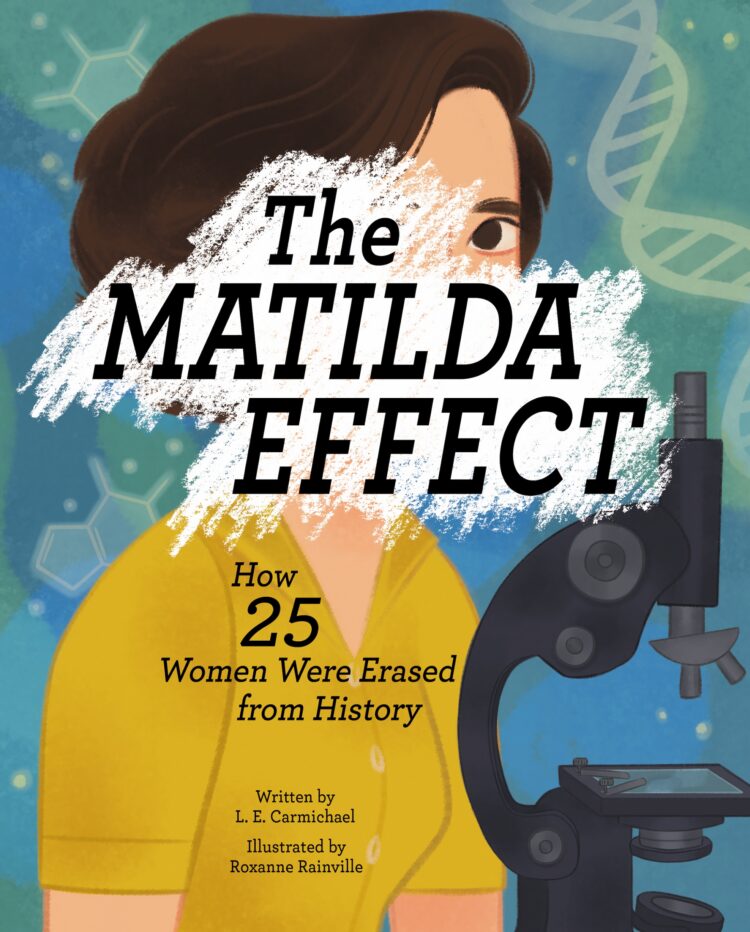
Rossiter defined the “Matilda Effect” as “men getting credit for things women did.” But as these example suggest, there’s more than one way for a woman to be erased. In fact, while writing my children’s biography collection, THE MATILDA EFFECT: HOW 25 WOMEN WERE ERASED FROM HISTORY, I identified six different mechanisms of erasure:
- The Matilda Effect: affecting women in STEM, the arts, and all other fields of awesomeness
- Disinformation campaigns: by historians who omitted or changed details of a woman’s story
- Self-erasure: women who rewrote their own stories to protect themselves from prejudice or discrimination
- Disguise: a woman pretending to be a man so she could do stuff women weren’t allowed to do
- It’s classified: female soldiers and spies whose accomplishments were labelled Top Secret or otherwise officially withheld
- The isms: the one that leads to all the other ones. I’m talking about the combined effects of sexism, racism, colonialism, agism, ableism, homophobia, and all the other prejudices that make people think it’s OK to dismiss women’s contributions (and women themselves)
I also uncovered several cases that sound a lot like the “Matthew Effect” – cases where everyone kept talking about one woman (like Florence Nightingale) and stopped talking about another woman who was equally amazing (like Mary Seacole).
What’s fascinating (and by “fascinating,” I mean “enraging”) is that Matilda Joslyn Gage herself was a victim of this “Matthew effect” style of erasure. Matilda, Elizabeth Cady Stanton, and Susan B. Anthony fought side-by-side for women’s rights. But Anthony routinely took credit for things Matilda had done, and Elizabeth often sided with Anthony. After Matilda died, her former partners deliberately wrote her out their history of the American woman’s suffrage movement.
In the meantime, here’s what Matilda herself had to say about the importance of the fight for women’s rights that continues, in North America and around the world today:
The longer I work, the more I see that woman’s cause is the world’s cause. No other reform ever equalled this in its magnitude and its prospective results. Not one class, nor one race, but the half of all humanity is, through it, to be raised from the despotism of the past into the full liberty of Christian responsibility and opportunity.
You can read Matilda’s full story in chapter thirteen of THE MATILDA EFFECT: HOW 25 WOMEN WERE ERASED FROM HISTORY, which is coming Fall 2026 from Kids Can Press. Subscribe to my email newsletter to download a FREE Women’s History Month Resource Kit, and for details on exclusive bonus content for subscribers who pre-order the book.