One of my goals for my new children’s book, THE MATILDA EFFECT: HOW 25 WOMEN WERE ERASED FROM HISTORY, was to include as much diversity as possible. I wanted a wide range of:
- Time periods
- Geographic locations
- Social classes (rich, poor, and middle class women)
- Education levels (from women with PhDs to women who were never taught to read)
- Fields of awesomeness (science, arts, sports, business, politics, war…)
- Mechanisms of erasure (disguise, stolen credit, a whole lotta sexism…)
And of course, I wanted the kinds of diversity that people usually call “Diversity, Equity, and Inclusion.” The kinds of diversity that would allow all young readers to see themselves, and to find a role model, in the pages of this book.
To that end, I thought readers might find this breakdown helpful. You can download the spreadsheet here if you like, or simply browse below.
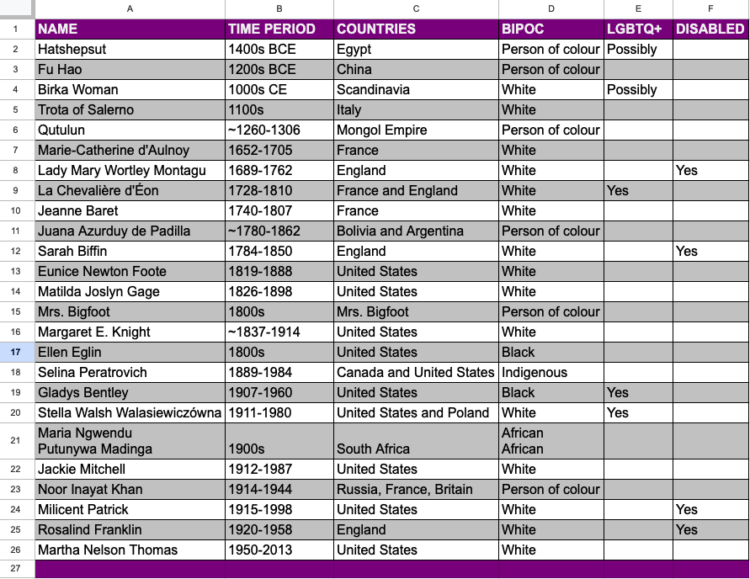
Some things to note:
- In the BIPOC column, I used Black to refer to Americans, and African to refer to indigenous African people living in Africa. If this is inappropriate, please let me know so I can correct the sheet!
- Other authors have done it, but I am not comfortable inferring a woman’s membership in the LGBTQ+ community unless the woman’s own writings or behaviour make her identity crystal clear. After all, in cultures or time periods where women were forced to marry for social status or financial security, we can’t assume someone was straight just because she married a man. So:
- if there’s a “yes” in this column, the evidence is convincing
- if there’s a “possibly,” it’s because historians interpret the available evidence differently
- if the column is blank… we might never know
- I’ve defined disability as a condition that affected the woman’s ability to support herself, or significantly changed the way her society viewed her:
- Lady Mary Wortley Montagu survived smallpox, but her face was terribly scarred by it… and people treated her differently after she lost her “legendary beauty”
- Because Sarah Biffin was born with a limb difference, most jobs in her society were inaccessible to her
- Milicent Patrick had chronic migraines that probably contributed to her decision to quit her job at Disney
- Rosalind Franklin’s cancer caused debilitating pain that affected her ability to work.
Recognizing that human diversity is HUMAN is an important step on the path to a fair and equitable society. Matilda Joslyn Gage knew that. In 1881, she wrote:
To those who fancy we are near the end of the battle, or that the reformer’s path is strewn with roses, we say them nay. The thick of the fight has just begun; the hottest part of the warfare is yet to come, and those who enter it must be willing to give up father, mother, and comforts for its sake. Neither shall we who carry on the fight, reap the great reward. We are battling for the good of those who shall come after us; they, not ourselves, shall enter into the harvest.
Keep fighting the good fight, y’all. There are action items at the back of THE MATILDA EFFECT to inspire you – pre-order your copy today! You can also help me celebrate Science Literacy Week by spotlighting historical women in STEM, because the contributions of women in STEM are (unfortunately) still being erased today.
I’ll be featuring one woman a day for the rest of this week; on the last day, I’ll share a free Canadian Women in STEM Reading List for Kids. Stay tuned!
In the meantime, be sure to subscribe to my email newsletter to receive your FREE Women’s History Month Resource Kit. Because it’s not just Science Literacy Week in Canada, it’s also Women’s History Month!
See you tomorrow, for the first post in the Erased Women in STEM Series!