If you’ve been on the internet for more than five minutes, you know that it’s a quick and powerful way of finding an answer to pretty much any question.
You also know that “answers” on the internet can be irrelevant, incomplete, or entirely incorrect. Identifying true facts in a sea of misinformation (inaccurate info) and disinformation (inaccurate info that is intended to deceive you) is getting harder every day.
The internet is a great place to start looking for information, but it’s a terrible place to finish. Especially if you’re looking for information about members of marginalized groups… like women erased from history.
That’s because disinformation is one of the major mechanisms of erasure. Online, deliberate “fake news” gets compounded by innocent mistakes (misinformation)… meaning researchers interested in the truth have to trace every fact back to its original source (or at least, as close to the original source as it’s still possible to get).
That’s why some of the information in The Matilda Effect: How 25 People Were Erased from History conflicts with what you’ll find online. I’ve created a list of all the conflicts I’m aware of, describing the reliable sources I used instead – you can download that here! For this post, I wanted to highlight a couple of examples, and talk about why I think these particular errors are both persistent and widespread.
Sarah Biffin Had Acheiropodia (Not Phocomelia)
Sarah Biffin (1784-1850) was a painter who was born with a limb difference called acheiropodia. Between first draft and final layout of The Matilda Effect, at least six different people at Kids Can Press reviewed my chapter about Sarah and told me, “The internet says she had phocomelia.”
I will tell you what I told every single one of them: the internet is wrong. Here’s why.
Human fetuses start to grow limbs when they are about 26 days old. If something unusual happens during limb development, the baby might be born with a limb difference.
Babies with acheiropodia are born without hands and feet. They are also usually born without the lower long bones of their arms (radius and ulna) and legs (tibia and fibula), or those bones might be present but shortened.
In contrast, babies with phocomelia are usually born with hands and feet, but without any of the long bones of the arms or legs (upper or lower). In other words, their hands and feet are usually connected directly to their torsos.
Here’s a portrait that Sarah Biffin painted of herself, probably in the 1820s:
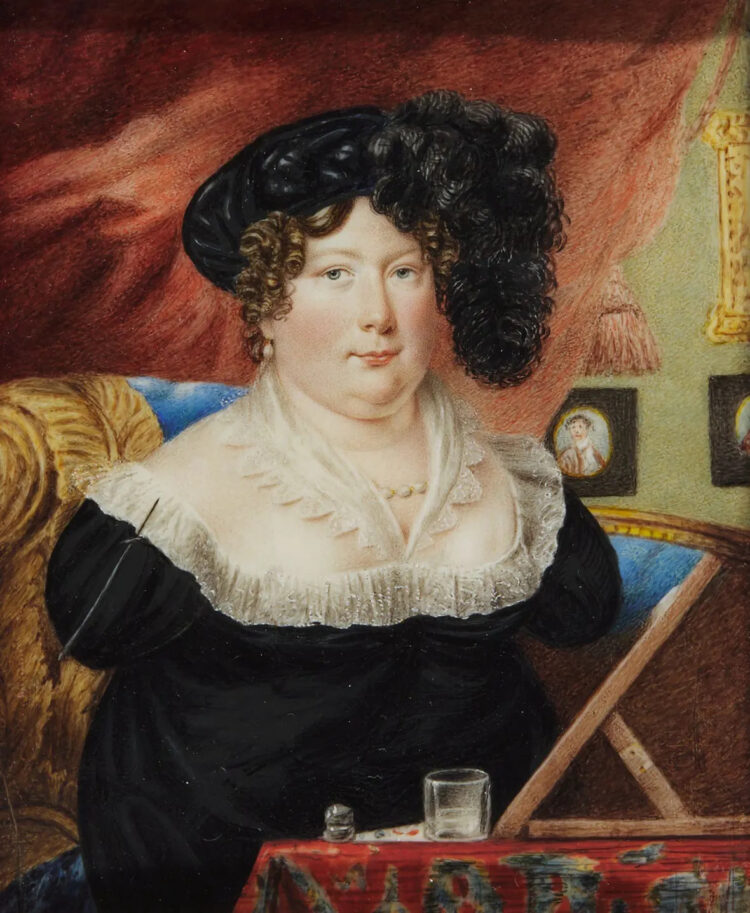
Her written description of her own body (in a letter held by the British Museum) also confirms that acheiropodia is the most appropriate modern word for Sarah’s limb difference.
The idea that Sarah had phocomelia is misinformation – an honest mistake with no intent to deceive. But where did the error come from in the first place? I can’t prove it, but I suspect it’s because phocomelia is famous. In the 1950s and 1960s, pregnant women around the world were given a drug called thalidomide to help with their morning sickness. And when tens of thousands of those mothers gave birth to babies with limb differences, we found out that thalidomide can cause phocomelia.
If people have heard of a limb difference called phocomelia, it’s easy to make the incorrect assumption that all limb differences are called phocomelia. And once that error appears online, it starts to spread.
If you’re looking for accurate information on limb differences online, I recommend:
Genetic and Rare Diseases Information Center
Armand Marie Leroi’s book Mutants: On Genetic Variety and the Human Body is also an excellent medical reference, but comes with major content warnings surrounding use of medical framing and terminology in describing disability.
Ready for another example?
When Misinformation Meets… Other Misinformation
For hundreds of years, doctors in Western Europe learned medicine on the job from older, more experienced doctors. Some were men, but others were female midwives and healers. Those women were vital in cultures — like that of 12th century Salerno, Italy — where men weren’t allowed to see or touch the intimate parts of women’s bodies, even when the woman was giving birth!
Starting in the 12th century, however, medicine increasingly became something taught in medical schools, using medical books. At the time, few women were taught how to read, which meant they could no longer learn medicine. As medicine became increasingly professionalized and regulated, most European countries made it illegal for a woman to practice medicine.
These changing attitudes towards female doctors changed the way people interpreted the Trotula, a famous 12th century book on women’s medicine. Originally, everyone believed it had been written by an accomplished female healer named Trotula, from Salerno, Italy. But in 1566, a man named Hans Kaspar Wolf declared that the Trotula had actually been written in the 1st century by a former Roman slave named Eros Juliae. No one believed the bit about Eros, but quite a few people were willing to believe that the author of the Trotula was really a man. That’s because (wait for it)…
This book on women’s medicine was so important, there’s no way a woman could have written it.
By the 20th century, male historians had even given that hypothetical man a new name: Trottus. There are no records of anyone named Trottus ever living in Salerno, but why let facts get in the way of a good theory?

While this “Trotula was a real man” thing was going on, other historians were working on a second theory – one equally unencumbered by fact! It seems to have started in the 1600s, when Antonio Mazza claimed that Trotula and several other female doctors had been professors at the university of Salerno. Salvatore de Renzi embellished the idea, and in the 20th century, feminist female doctor Kate Campbell Hurd-Mead picked up on it. In this version, Trotula was born in 1050 to the noble Ruggiero family of Salerno. She became a famous healer and was so beloved that, when she died in 1097, her funeral procession was 3 km (about 2 miles) long. This biography is hugely popular today, appearing across the internet and in quite a few peer-reviewed journal articles I encountered during my research. But is it true?
No. Not even a little bit.
Historian Monica Green has busted both of these myths. You can about her work in The Matilda Effect, but if you want to dig into the fascinating details, I recommend her books:
So. If we know that neither of these stories about Trotula – who in real life was probably named Trota or Trocta – why are they still so popular?
In the case of the first one, I’m pretty confident calling that sexism. And in the case of the second, I suspect a deep and totally understandable desire to push back against sexism. Once women had been kicked out of medicine, it was really hard for them to get back in. And if you are a woman in a male-dominated field, it’s only natural to look for role models: women who succeeded in doing the really hard thing that you are also trying to do. And if that woman succeeded in doing the hard thing hundreds of years ago, then she’s not just a role model: she’s a legacy.
So Where Does This Leave Us?
With a reminder to keep asking questions, but always be skeptical of the answers. Ask for sources, look for evidence, and definitely don’t trust AI.
As the seas of misinformation and disinformation continue to rise, the truth is still out there. We just have to keep swimming. If you need some water wings, I’ve created this free resource for spotting misinformation about women (and other marginalized humans), whether they’ve been erased or not: