 When the internet first exploded, lo these many moons ago, there was a whole lot of hand-wringing over the death of nonfiction books. Who’d bother reading a book when they could just google the answer?
A lot of us, it turns out. Because the internet was – and is – often wrong. Anyone can write anything they want online, regardless of whether what they’ve written is factual.
Then AI arrived, and the hand-wringing began again, because who’d bother reading a book when they could just ask a chatbot?
A lot of us, it turns out. Because AI gets a lot of its information from the internet, which is *checks notes* often wrong. Ever hear the phrase “garbage in, garbage out”? Programmers have used it since the invention of computers, and it means that, if you give the robots bad data, they will give you bad answers. Because the robots can’t tell the difference.
And AI is even worse, because it’s not just wrong, it hallucinates, which is a polite way of saying it lies. It lies shamelessly, and to your face, because the robots don’t have morals. For a recent example, check out this hilarious and horrifying post about all the cats author Chuck Wendig does not actually possess (content warning for strong language).
Let’s contrast this “who cares if it’s not true” nightmare with the way nonfiction books gets made.
Ensuring Accuracy in Children’s Nonfiction Books
Step 1. Research, a process which can take literal years.
In the research phase, I learn everything I possibly can about my topic. I read books, and the internet, but also primary sources: original reports written by scientists and other professional researchers. I do interviews with experts to learn about the bits they didn’t write down.
I compare everything I read and hear against everything else I’ve read and heard. I ask whether the person I’m reading or listening to is manipulating my emotions or expressing a bias – if the article about climate change was written by a fossil fuel company, it ain’t credible.
When I find discrepancies, I follow the trail to the original sources. It’s the only way to figure out what’s true, to the best of our available knowledge at the time.
Step 2. Writing, which might also take years!
Draft, fill in gaps with more research, revise.
Repeat, repeat, repeat.
Step 3. Fact checking, for literal weeks.
People use the phrase “fact checking” to mean a variety of things. Here’s what it means when I do it:
I start at the beginning of my manuscript and work line-by-line to the end, comparing everything I’ve written to the original source. Not my notes on the source – the original text of the original source. This is the only way to be sure I haven’t accidentally transposed the numbers in a year, or misunderstood something that I read when I was tired.
Step 4. Working with an editor at a publishing house (for more months or years).
Sure, the editorial process is about making my writing the best it can possibly be. But it’s also about challenging the accuracy of what I’ve written. My editor asks me questions that force me to re-evaluate my understanding of my research. And often, force me to do more research to verify something I thought was true.
Spoiler alert: we always find something in the manuscript that wasn’t true.
Step 5. The expert review.
The years I’ve devoted to working on a book can never equal the decades of expertise accumulated by someone who’s dedicated their life to the topic. Experts read the entire manuscript, identifying errors and adding nuance – and sometimes, entirely new directions!
Step 6. The sensitivity review.
Sensitivity reviewers check accuracy of representation, calling out the blinders and biases about other experiences that every single human possesses, no matter how well-researched or well-intentioned we might be.
Step 7. The copy edit.
Yet another human checks facts and figures in the book, asking is this correct? Are you sure? Like, really, really sure?
Step 8. The proofread.
At least three people check the manuscript for typos, particularly the kind that change the meaning of the text. And yes, typos can do that.
Step 9. Publish a book that’s as accurate as humans can make it.
And often (especially in the case of science books) I learn there’s a new discovery that means something I wrote is no longer true…
Let me give you an example of why every single step in this human process matters, now more than ever.
The Case of the Totally False Fingerprinting Propaganda
The Industrial Revolution of the 19th century was responsible for more than just technological breakthroughs and the novels of Charles Dickens. It also caused a major spike in crime rates, as people moved from the countryside into the cities looking for work – and turned to crime when they couldn’t find any.
Urbanization also made it harder to reliably identify repeat criminals. In small villages, everyone not only knew everyone, they knew with a high degree of certainty which of their neighbours was likely to blame for the local crime wave. Not so much in cities, where many people lived surrounded by strangers. Witness reports were often useless, because criminals wore masks or otherwise changed their appearances, and there was no such thing as photo ID. Many governments instituted harsher penalties for career criminals, but these penalties couldn’t be applied without certainty that the suspect in custody was actually a repeat offender.
Enter Alphonse Bertillion. A file clerk with the Paris police, he was the fussy, meticulous son of a statistician, and he had a revolutionary idea. A criminal could change his hair cut or mustache or even his name, Bertillon believed, but he couldn’t change his bones. Careful measurements of body dimensions, like the length of the finger or the long bone in the thigh, could be combined to produce a one-of-a kind profile – the first (Western) scientific basis for identifying human beings.
 The Paris police took a while to come around to this idea, but in its first year of use, Bertillon’s system, called anthropometry, identified 300 career criminals. By 1888, it was implemented in all French police stations and quickly spread around the world.
Until 1903, when a man named Will West was taken to Leavenworth Prison in Kansas and identified based on his measurements as a repeat offender. But West swore he’d never set foot in the prison before. By a bizarre coincidence, West’s measurements perfectly matched those of William West – a man already imprisoned in Leavenworth! While the men did, in fact, bear a strong resemblance to each other, their fingerprints were completely different. This incident was one of the reasons fingerprinting replaced anthropometry as the standard method of legal identification.
Or was it?
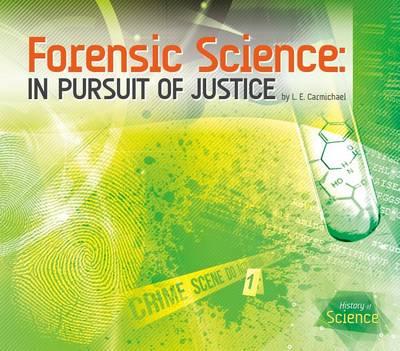
When I was researching Forensic Science: In Pursuit of Justice, I came across this story in not one, not two, but several of my reference books. Since it appeared to be well-verified and was the perfect anecdote to explain how fingerprinting came to dominate criminal identification, I included it in the initial draft of Chapter 6. Imagine my shock when the expert reviewer for the book told me the entire incident was a myth.
A myth.
As Simon A. Cole explains in his book Suspect Identities (a volume my expert reviewer kindly referred me to), the West story was carefully fabricated and cleverly circulated as a means of promoting fingerprinting as a superior alternative to anthropometry. And while fingerprinting ultimately replaced Bertillon’s method due to its numerous advantages, this incident was not one of them.
In conclusion…
The internet is filled with “facts” that have been repeated and republished so many times, they’ve acquired a veneer of truth… even when they are entirely false. And now those “false facts” are the raw material for the AI searches and chat bots.
This is one of many reasons that I do not use AI – ever, for anything. And it’s one of many reasons that nonfiction books – written, edited, and fact-checked by humans – matter more than they ever have. Especially books for young readers, who may not have the broader context and critical thinking skills to evaluate what they read.
So next time you have a question, set down your device, and pick up a book.
1 Comment on ‘Accuracy in the Age of AI: Why Nonfiction Books Matter More Than Ever’