It’s Science Literacy Week, and what better way to celebrate than by spotlighting women in science, technology, engineering, math, and medicine who never got the credit they deserved?
I’m kicking off this Erased Women in STEM series with Rosalind Franklin because:
- she’s the reason we know what DNA looks like, and
- I’m a female geneticist by training, and
- science dudes tried to muscle in on my research too, so
- I take what happened to Rosalind pretty personally.
Of all the women in my upcoming children’s book, THE MATILDA EFFECT: HOW 25 WOMEN WERE ERASED FROM HISTORY, Rosalind’s story is probably the most widely-known. So for today’s purposes, I won’t go into all the details of the data theft and the deliberate disinformation about Rosalind’s research and character that circulated after her death. I’m just going to be grateful that people have realized how extraordinary her work really was. Aaron Klug, a scientist Rosalind worked with after she left the DNA project, put it this way:
It takes imagination and intellect to know precisely what experiments to do, to design them, prepare the specimens and then to observe the results. She worked beautifully. Her single-mindedness made her a first-class experimentalist, with the sort of skill that blends intelligence and determination.
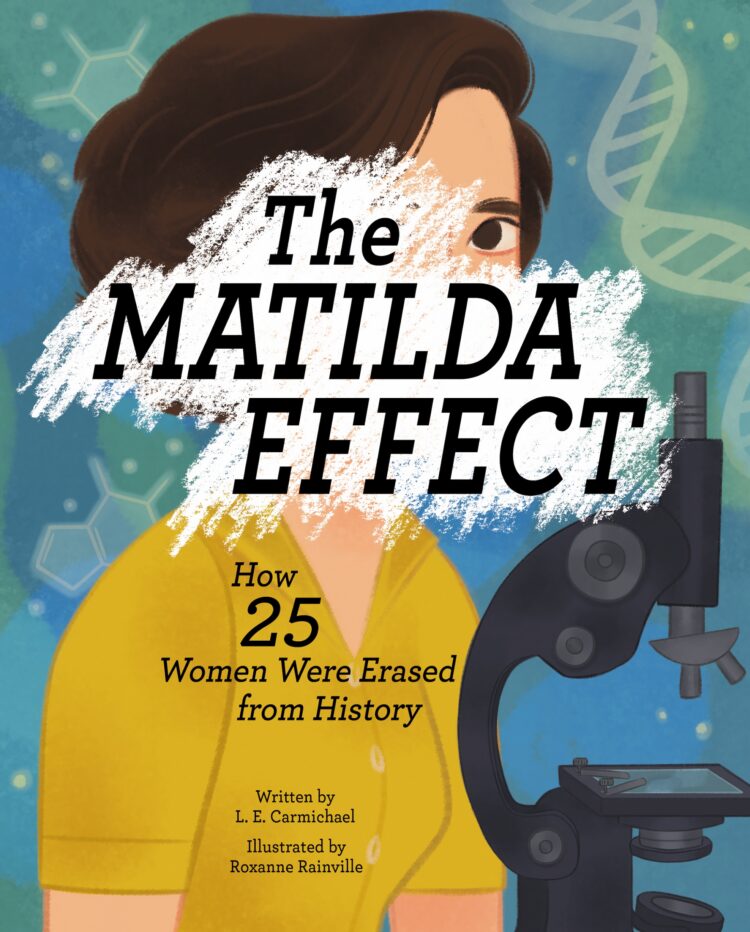
That’s Rosalind on the cover!
Rosalind’s specialty was X-ray crystallography, a groundbreaking new method of photographing molecules. Regular photography produces images by capturing light waves that bounce off of objects and into the camera’s lens. In crystallography, film captures X-rays that bounce off of minuscule molecules. The X-rays form a pattern of spots that can be decoded to reveal the molecule’s shape. One photograph takes up to 100 hours to develop.
In Rosalind’s day, crystallography was often considered “women’s work” because it was slow and painstaking and generally perceived as “support” for the men doing the “real” research (much like the work of Katherine Johnson and other female “computers” who used to do the math at NASA). This perception of crystallography as less-important grunt work might be another reason male scientists didn’t hesitate to use Rosalind’s data without her knowledge or permission.
Coming tomorrow: Margaret E. Knight, professional inventor!
If you haven’t already signed up for my email newsletter, now is a great time. New subscribers receive a FREE Women’s History Month Resource Kit. Subscribers who pre-order THE MATILDA EFFECT get some extra bonus goodies, too, including an exclusive ticket to the virtual book launch.