When I decided to write a book about women who’d been erased from history, the first question I had to ask became: What is a woman?
The answer’s not nearly as clear as many people want to believe. For starters, human understandings of gender have changed dramatically throughout history, and still vary among cultures around the world. That’s because gender identity isn’t only about biology. It’s also about behaviour.
I quickly realized that “What is a woman?” was the wrong question. What I needed to be asking was:
“What is a woman, according to the people in the time and place where this interesting person I’m reading about happened to live?”
And most importantly, “Would this interesting person have described herself as a woman, given the definition of womanhood in use at the time?”
Behaviour relative to society’s definition of womanhood unlocked the whole book for me, and here’s why: many of the women in The Matilda Effect were erased from history because their personal ideas of what a woman could be and do did not match what their societies thought a woman “should” be and do. They were behaving in ways that violated the definition of womanhood their societies were using at the time.
Case in point: Hatshepsut, King of Egypt.
I came face to face with Hatshepsut back in 2000, when Tech Support and I were lucky enough to visit the Egyptian Museum in Cairo. Our guide pointed at the enormous, decapitated head of a kingly statue and asked, “Man or woman?” I remember looking at the delicate features on the massive sculpture and suspecting some kind of trick.
Nineteenth-century Egyptologists absolutely suspected one. These early archaeologists were almost all white male Europeans, and they could not believe that a woman had become king without resorting to treachery. In their view, “ruling a kingdom” was not acceptable behaviour for a woman. Which I find hilarious, because at the time, England was ruled by *checks notes* QUEEN VICTORIA.
So, according to Victorian standards of womanhood, Hatshepsut was doing a bad, bad thing. But what about the standards of Ancient Egypt? And the standards of Hatshepsut herself?
The only things we know about Hatshepsut are the things she wanted us to know – the public-facing record of statues and temples and carvings on walls where anyone could walk by and read them. It’s like trying to reconstruct someone’s inner life based on their Instagram profile – the evidence is incomplete and often deliberately misleading.
But let’s have a go.
The first thing to note is that Hatshepsut’s journey to the throne happened in stages:
- She started out as a royal princess
- She became Great Wife of King Thutmose II, and mother of his daughter
- When Thutmose III became King at age two, Hatshepsut became his Regent
- Years later, she named herself Co-King of Egypt, and ruled at Thutmose III’s side
At each step of the journey, Hatshepsut’s public-facing image shifted:
- As princess, paintings and sculptures portrayed her as a beautiful girl in a dress, sitting or standing passively with her feet together. This is how all women were traditionally represented in Ancient Egyptian art.
- After she became regent, artwork portrayed Hatshepsut wearing a king’s headdress and false beard
- Later, she’s dressed in a man’s kilt, with her bare female chest on display
- Later still, artists masculinized the shape of Hatshepsut’s body and positioned her in the active, walking posture of a King
Based on these changes, Ancient Egyptians probably agreed with Victorian Era Egyptologists: “being king” was not a behaviour normally associated with “being a woman.” But was Hatshepsut pretending to be a man, to give her people the kind of king they expected to see? Or did she really identify as a man?
Unless someone finds her diary, we’ll never know how Hatshepsut identified when no one else was watching. For my money, I don’t believe Hatshepsut was transgender. I believe that her answer to the question “What is a woman?” had simply expanded to included the behaviours associated with being a “king.” After all, inscriptions on her kingly statues almost always contain an indication of female gender. My favourite of these?
“His Majesty, Herself.”
—
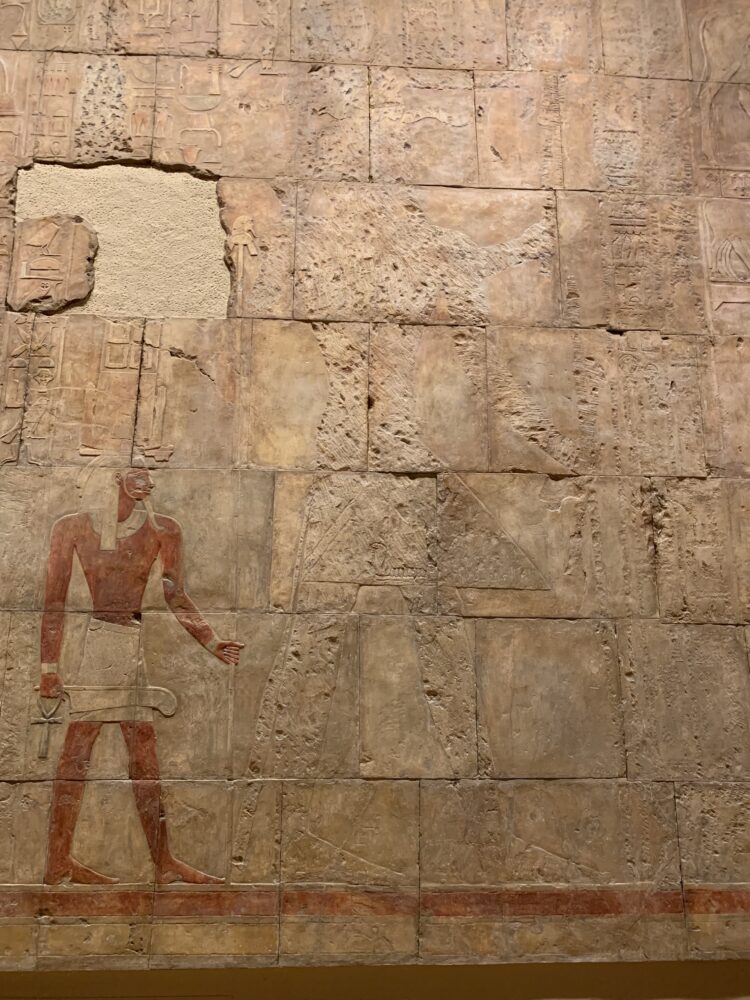
Look closely – see the outline of a body in the centre of the photo? That was Hatshepsut. Years after she died, her co-king Thutmose III ordered an erasure campaign that literally chiselled Hatshepsut off the walls. Read The Matilda Effect for the full story. (Photo taken by L. E. Carmichael at the Royal Ontario Museum)
You can read Hatshepsut’s full story in chapter one of The Matilda Effect, which is coming Fall 2026 from Kids Can Press. Subscribe to my email newsletter to download a FREE activity guide, and for details on exclusive bonus content for subscribers who pre-order. In the meantime, here’s some cool info about the search for Hatshepsut’s mummy that I couldn’t quite squeeze into the book!
The Case of the Missing Mummy
Howard Carter—the archaeologist who found King Tut’s tomb—also excavated Hatshepsut’s tomb in 1903. Hatshepsut’s mummy wasn’t there. It may have been destroyed during her erasure, or moved to protect it from tomb raiders.
In 2007, The Discovery Channel announced the discovery of the missing mummy. A team led by Zahi Hawass matched a tooth, found in a box with Hatshepsut’s name on it, to a mummy with a missing tooth that was found near the King’s tomb.
This proves that the tooth came from this mummy. It does not prove that the mummy is Hatshepsut. Many Egyptologists doubt the match, for several reasons:
- The name on the box does not prove that the tooth in the box belonged to Hatshepsut, especially since royal body parts were typically stored in jars, not boxes.
- There were no artifacts with the mummy that could confirm its identity.
- The mummy belonged to a woman who was at least 50 years old when she died—about 10 years older than Hatshepsut.
- The body was poorly mummified, while Hatshepsut would have received the royal treatment.
It’s definitely possible that Hatshepsut’s mummy survives to this day; this particular mummy probably isn’t it.