For a long time, scholars were obsessed with straight lines, hierarchies, and the idea of “progress.” That sort of linear (and often racist) thinking led them to describe magic as a thing only “primitive” people believed in. As civilizations “advanced,” they replaced magic with religion. Societies at the highest levels replaced religion with science.
As archaeologist Chris Gosden explains in his fascinating book, Magic: A History, this linear progression is completely false. For starters, magic and religion and science don’t replace each other, they coexist. Even the quickest glance at the complexities of modern Western culture shows us that! For seconders, magic and religion and science aren’t clear cut categories, but a Venn diagram with lots of overlap. And all three modes of thought are ways to make sense of the universe… and to influence it.
In my view, magic is applied folklore in the same way that engineering is applied science, and folklore and science are my twin passions. They’re two sides of the same coin, two ways of making meaning out of chaos. When combined, science and folklore can increase our access to both kinds of wonder:
Wonder (noun): an emotional state of awe and astonishment
Wonder (verb): to be curious, to ask questions, to act from a desire to know more
An example will help explain what I mean!
A Bird’s Eye View of the Furcula
A little vocab here, so bear with me.
“Vertebrate” is the word scientists use to describe animals with backbones, including fish, birds, reptiles, and mammals. Within the vertebrates is a group called the “tetrapods,” which means “four foots.” Mammals, birds, and snakes are all tetrapods, even though snakes decided feet were unnecessary and dispensed with them later in their evolution!
In tetrapods, including humans, limbs connect to the backbone via girdles. Back legs (or legs, as humans call them) connect through the pelvic girdle: what humans call our hips. Wings, front legs, or arms connect through the pectoral girdle: what humans call our shoulders. In humans and many other tetrapods, the pectoral girdle includes two bones called the clavicles, or collar bones. But some critters went another way.
It began with the theropods: the group of carnivorous dinosaurs that includes fan-favourite Tyrannosaurus rex. Theropods had sharp teeth, three-toed back feet, and light skeletons with hollow bones. Theropods also had a furcula – a single bone made of two clavicles that had fused together in the centre:
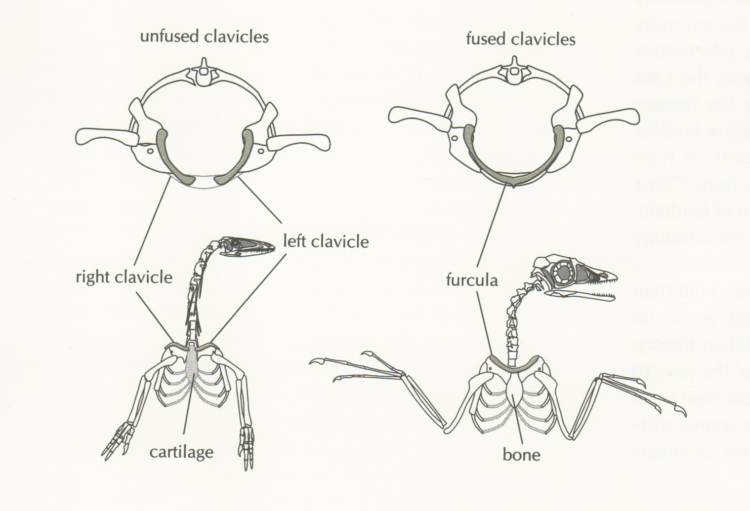
From Dingus and Rowe (1998) The Mistaken Extinction: Dinosaur Evolution and the Origin of Birds
As you can see (in grey), the dinosaur on the left has two separate clavicles (collar bones), while the theropod dinosaur on the right has a single furcula. When palaeontology was a brand new science, we didn’t know it was possible for reptiles to have furcula. Scientists had only seen such a bone in living bird species. The presence of the furcula in theropod dinosaurs like Deinonychus was one piece of evidence supporting a major scientific breakthrough – the realization that modern birds evolved from dinosaurs.
(In fact, birds are dinosaurs in the same way that humans are mammals. So next time someone uses dinosaurs as a metaphor for extinction, just point to the nearest pigeon!)
The furcula first evolved in land-bound dinosaurs. Scientists think that, because the furcula increases the strength and stability of the pectoral girdle, it was a useful adaptation for predatory theropods who used their forearms to catch and hold their prey. Except for T. rex. No one knows what those stubby little arms were used for!
As some dinosaurs hopped onto the evolutionary pathway towards birdhood, the furcula acquired a new function. This happens a lot. So often, that there’s an official word for an adaptation, useful in one context, that turns out to be useful for something new: exapation. In the case of the furcula, a bone that strengthened the pectoral girdle also turned out to be essential in the evolution of a very birdy behaviour: powered flight.
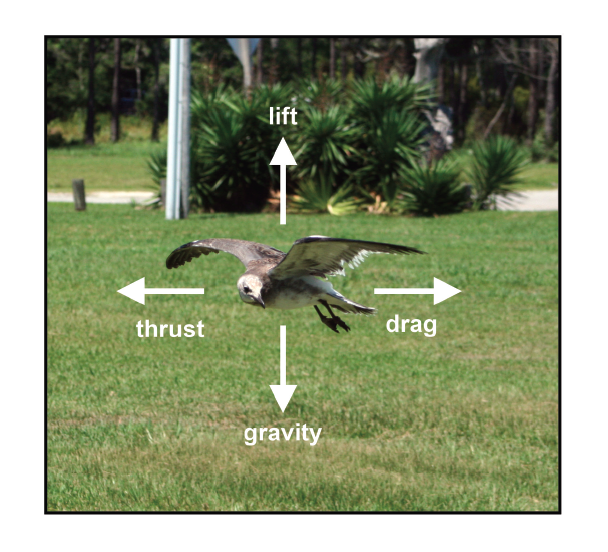
From Schweitzer et al (2021) Dinosaurs: How We Know What We Know
Unlike gliding, where animals spread their limbs and hope for the best, powered flight requires birds to flap their wings. One downstroke plus one upstroke equals one flap. During the downstroke, the bird’s strong pectoral muscles pull the wings towards the chest. This pushes surrounding air downward, generating an equal-but-opposite upward force called lift. That lift counteracts the downward force of gravity that would cause the bird to crash!
During the downstroke of the flap, some of the force exerted by the bird’s pectoral muscles gets stored inside its spring-like furcula. When that stored force is released, it helps push the bird’s wings back up. That reduces the amount of muscular force required to lift the wings during the upstroke, meaning it takes less food energy to flap! This springy action is so important that birds can’t fly with a broken furcula.
So much for science. Where’s the folklore? Well, it starts with a word non-scientists often use to describe the furcula…
…wishbone.
Breaking the Bone
Dinner’s over and the bird’s down to its bones: time to make a wish! Siblings grip the clean, dry furcula in the crooks of their pinkies, close their eyes, and pull. Crack! The person holding the biggest piece of bone will get her wish.
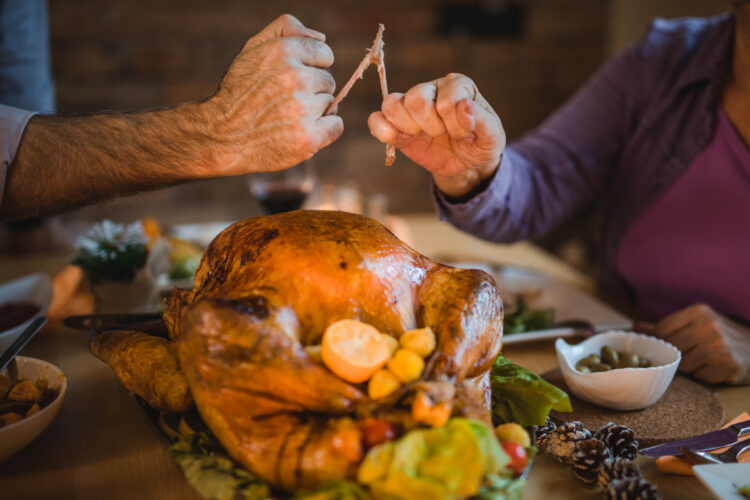
According to this cool article at Folklore Thursday, this folkloric tradition of wishing on a bird bone may date back to the Etruscans, an ancient people that believed birds could tell the future. Others argue wishbones are lucky because their shape resembles lucky horseshoes, or the groin from which human life emerges. We do know that the Ancient Romans were the first to break the wishbone—a change in the ritual that gave more people a chance at getting some of that good luck.
The English phrase “a lucky break” might refer to the wishbone tradition, which the British spread to their colonies around the world—along with roast dinners!
My little brother and I used to pull the wishbone after every Christmas turkey. I didn’t track the success of my wishes, so I can’t speak to the power of the pull, but we both looked forward to this weird little tradition!
Science + Folkore = Magic
So what does this example tell us about the connections between science and folklore?
Science is empirical, data driven, based on evidence and testability. It’s a way of observing the world and ourselves, of asking questions, and of thinking critically about possible answers. It’s an attempt to explain how the world works and why things happen.
Much folklore also attempts to explain how the world works and why things happen. But unlike science, which looks head on, folklore comes at these questions from the side. To paraphrase Emily Dickinson, folklore tells the truth, but tells it slant. Folklore operates through symbolism, coding, and metaphor. It’s a way of connecting with others and with something bigger than ourselves, of making meaning out of everyday life. Folklore helps resign us to the knowledge that many of the things that feel most resonant, most powerful in life, are the things we can’t fully explain.
Both modes of thought illuminate the darkness, finding connection in chaos. Both offer insights into our deepest selves, and glimpses of our universe’s hidden blueprints. And both put us on the pathway to wonder.
As Marina Warner explains in her seminal book on fairy tales (a category of folklore):
The verb ‘to wonder’ communicates the receptive state of marvelling as well as the active desire to know, to inquire, and as such it defines very well at least two characteristics of the traditional fairy tale: pleasure in the fantastic, curiosity about the real.
This is magic, and I am absolutely here for it. What about you?
Calling all teachers! If you’re looking for a fresh, engaging, scientifically-rigorous way to teach evolution, check out these FREE curriculum resources I helped create. They’re available in both elementary and middle/high school versions, and both contain LOTS more info about dinosaurs and the evolution of birds.
If you’re in Ontario, you can borrow the physical kits – including casts of real fossils! – from the Queen’s University Education Library.
Um–this is amazing. But of course it is.
Thanks! I had a lot of fun writing this one. The world is full of wonders.